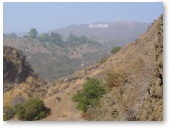
Bronson Canyon, only a few acres in size, is the remains of a rock quarry located at the southern edge of Griffith Park, just above Hollywood and within sight of that
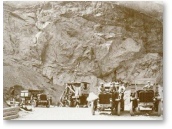 famous sign. The Union Rock Company operated the quarry from 1903 into the late 1920s, and crushed rock from it was used on local railways and roads. In 1919, the first movie filmed in the canyon, Lightning Bryce, was released by the National Film Corporation of America. Then once the quarrying in the canyon ceased, the site became a favorite location
for penny-pinching low budget studios, as well as a convenient filming place for the major studios. During the 1930s and 1940s, Bronson Canyon appeared in several serials and B-Westerns. In the 1950s, it became a breeding ground for the sci-fi generation flicks of that era. Through the years, even television has used Bronson Canyon on many movies and shows.
famous sign. The Union Rock Company operated the quarry from 1903 into the late 1920s, and crushed rock from it was used on local railways and roads. In 1919, the first movie filmed in the canyon, Lightning Bryce, was released by the National Film Corporation of America. Then once the quarrying in the canyon ceased, the site became a favorite location
for penny-pinching low budget studios, as well as a convenient filming place for the major studios. During the 1930s and 1940s, Bronson Canyon appeared in several serials and B-Westerns. In the 1950s, it became a breeding ground for the sci-fi generation flicks of that era. Through the years, even television has used Bronson Canyon on many movies and shows.
Located off Bronson Avenue in Los Angeles, Bronson Canyon is reached by a short walk over a bridge and across a gated driveway, then up a dirt road which winds approximately a quarter mile along the east side of Canyon Drive's dead-end. Upon arriving in the Canyon,
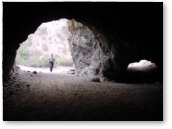
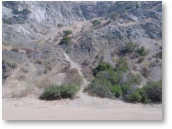 a large opening to a cave can be seen on the side of the hill to the right. This opening is actually a fifty-yard long tunnel carved out of the mountain rock that cuts through the mountain to a quarry on the other side. Half-way into the tunnel two other cave openings become visible, one on either side of the main tunnel. The main opening into the canyon
proper (quarry) is best recognized in the climactic scene of John Ford's The Searchers (1956), where Ethan Edwards (John Wayne) rides down the hill-slope pursuing niece Little Debbie (Natalie Wood) and, dismounting his horse, grabs the frightened Wood, raises her into his arms and says, "Let's go home, Debbie". Twenty-three years prior, John Wayne rode
a stagecoach through the main tunnel in the second of sixteen Lone Star installments, Sagebrush Trail (1933). In the early 1930s, this site became a favorite film location for a number of action cliffhangers produced by Mascot Pictures including King of the Wild (1931), The Lightning Warrior (1931), The Shadow of the Eagle (1932),
The Hurricane Express (1932), The Three Musketeers (1933), Mystery Mountain (1934), and The Phantom Empire (1935) where serial enthusiasts will recognize the cave opening to the left of the main tunnel (looking from within) as being the entrance to the 20,000-foot underground city of Murania. Other serials to use Bronson Canyon include
Universal Pictures' 13-chapter Flash Gordon (1936),
a large opening to a cave can be seen on the side of the hill to the right. This opening is actually a fifty-yard long tunnel carved out of the mountain rock that cuts through the mountain to a quarry on the other side. Half-way into the tunnel two other cave openings become visible, one on either side of the main tunnel. The main opening into the canyon
proper (quarry) is best recognized in the climactic scene of John Ford's The Searchers (1956), where Ethan Edwards (John Wayne) rides down the hill-slope pursuing niece Little Debbie (Natalie Wood) and, dismounting his horse, grabs the frightened Wood, raises her into his arms and says, "Let's go home, Debbie". Twenty-three years prior, John Wayne rode
a stagecoach through the main tunnel in the second of sixteen Lone Star installments, Sagebrush Trail (1933). In the early 1930s, this site became a favorite film location for a number of action cliffhangers produced by Mascot Pictures including King of the Wild (1931), The Lightning Warrior (1931), The Shadow of the Eagle (1932),
The Hurricane Express (1932), The Three Musketeers (1933), Mystery Mountain (1934), and The Phantom Empire (1935) where serial enthusiasts will recognize the cave opening to the left of the main tunnel (looking from within) as being the entrance to the 20,000-foot underground city of Murania. Other serials to use Bronson Canyon include
Universal Pictures' 13-chapter Flash Gordon (1936),
 Republic Pictures' 14-chapter Robinson Crusoe of Clipper Island (1936), 12-chapter Zorro Rides Again (1937), 15-chapter Dick Tracy Returns (1938) and The Lone Ranger Rides Again (1939), and 12-chapter Hawk of the Wilderness (1938) and Adventures of Captain Marvel (1941). During the same period of time a number of B-Westerns were also filmed here including Hello Trouble (1932) starring Buck Jones, Honor of the Range (1934) starring
Ken Maynard, and Coyote Trails (1935) starring Tom Tyler. In Tim Holt's oater Dude Cowboy (1941), the cave was the hideout for a money counterfeiting ring. The climactic shoot-out and horse stampede in this RKO film also takes place inside the main tunnel, with the entrance to the cave easily recognizable. The Vampire Bat (1933) starring Lionel Atwill was also filmed at Bronson, as were parts of Frank Capra's classic Lost Horizon (1937) starring Ronald Colman.
Republic Pictures' 14-chapter Robinson Crusoe of Clipper Island (1936), 12-chapter Zorro Rides Again (1937), 15-chapter Dick Tracy Returns (1938) and The Lone Ranger Rides Again (1939), and 12-chapter Hawk of the Wilderness (1938) and Adventures of Captain Marvel (1941). During the same period of time a number of B-Westerns were also filmed here including Hello Trouble (1932) starring Buck Jones, Honor of the Range (1934) starring
Ken Maynard, and Coyote Trails (1935) starring Tom Tyler. In Tim Holt's oater Dude Cowboy (1941), the cave was the hideout for a money counterfeiting ring. The climactic shoot-out and horse stampede in this RKO film also takes place inside the main tunnel, with the entrance to the cave easily recognizable. The Vampire Bat (1933) starring Lionel Atwill was also filmed at Bronson, as were parts of Frank Capra's classic Lost Horizon (1937) starring Ronald Colman.
The evolution of space exploration inspired the production of many sci-fi flicks throughout the 1950s, and Bronson Canyon became a favorite locale for a number of cinematic outer space "landings". Films such as Unknown World (1951), Day the World Ended (1956), Invasion of the Body Snatchers (1956), It Conquered the World (1956),
I Married a Monster from Outer Space (1958), Earth vs. the Spider (1958) and Invisible Invaders (1959) have become cult favorites, and all featured scenes shot in Bronson Canyon. In Invasion of the Body Snatchers (1956),
 Dr. Miles Bennell (Kevin McCarthy) and Becky Driscoll (Dana Wynter) hid from the pods underneath wooden beams in a hole dug in the cave's floor. This hiding place is also where Miles kisses Becky and then realizes with horror that she is no longer human.
Bronson Canyon has appeared in a variety of television program genres, but most frequently in sci-fi and Westerns. Most TV Westerns produced during the 1950s-1970s were lensed at Bronson at one time or another, and these include The Lone Ranger, The Adventures of Rin Tin Tin, Gunsmoke, Tales of the Texas Rangers, The Californians, Have Gun - Will Travel, Tombstone Territory, Bat Masterson, The Rough Riders, Bonanza, Rawhide, Shotgun Slade, Outlaws,
The Virginian, The Wild Wild West,
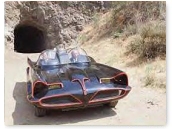 The Guns of Will Sonnett, The High Chaparral, and Little House on the Prairie. In the first Lone Ranger episode, Enter the Lone Ranger (9/15/1949), Bronson Canyon is utilized as Bryant's Gap, the ambush site of the Texas Rangers by the Butch Cavendish gang. Everyone is killed except for Dan Reid, who manages to crawl to one of the cave's openings where he finds a water spring. Reid stays alive long enough to be serendipitously found by his childhood friend Tonto, who nurses him back to health to become the Lone Ranger. This episode is noteworthy because in all likelihood it is the first time that Bronson Canyon appeared on the miniature screen. In the 1960s, one of the cave's tunnel entrances was enhanced with green foliage and short shrubs and used as the Bat Cave entrance in the Batman television series starring Adam West and Burt Ward. More recently, Bronson Canyon has been seen in Wonder Woman, Fantasy Island, MacGyver, Starman, The Adventures of Brisco County, Jr. and Star Trek: Voyager.
Today, Bronson canyon is enjoyed by joggers, hikers, independent film producers, and film location buffs, and sometimes its caves serve as overnight shelter to homeless transients.



