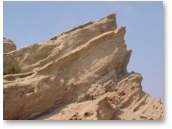
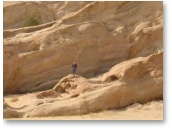
 Vasquez Rocks is one of the movie industry’s most recognizable film locations. The rocks are a magnificent, south-facing hogback ridge formation that was created about 25 million years ago presumably by a violent earthquake along the San Andreas Fault that squeezed the rocks upward at a 45-degree angle toward the sky. They are now part of the 900-acre Vasquez Rocks Natural Area County Park located less than an hour north of Los Angeles and situated in the Aqua Dulce area, cradled by the San Gabriel mountain range on the west and the Sierra Pelonas to the north. This area was first occupied by ancestors of the Chumash and later by the Tataviam Indians (related linguistically to the Shoshone), who arrived around 450 AD and were responsible for the petroglyphs of volcanoes, suns, people, lizards and other creatures found in these rocks.
Vasquez Rocks is named for Tiburcio Vasquez, the notorious bandit who became known as the “Scourge of California.” Vasquez was born Jose Jesus Lopez on August 11, 1835, in Monterey, Alta California. His first brush with the law came in 1854, when he was involved in a saloon brawl in which a local constable was murdered.
 With the law in pursuit, Jose Lopez fled, changed his name to Tiburcio Vasquez, and embarked on a new life as a bandit. He joined a gang of desperados, and in time became leader of his own group which ranged up and down central and southern California. By age 20, Vasquez was rustling cattle and robbing freight wagons. He was captured in 1857, convicted of horse-stealing, and sent to San Quentin Prison. He escaped two years later and hid near Idria, only to be recaptured after a few months and returned to prison until his release in 1863. Returning soon to a life of crime, Vasquez served an additional three years in San Quentin. His exploits, which traversed the length of California, rivaled those of the more famous Joaquin Murieta, California's first real outlaw.
In 1871, Vasquez’s hideout became the craggy rocks which now bear his name. It is reported that he would occasionally ride into Newhall and steal horses while holed up at Vasquez Rocks. His ever increasing crime spree escalated to murder on August 13, 1873, when Vasquez and his gang raided the town of Tres Pinos, south of Hollister, and killed three people while robbing Snyder's General Store.
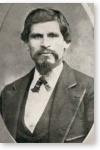 On November 12, 1873, he and his gang ransacked the town of Kingston, robbing and tying up all the male residents. Vasquez escaped to southern California, where he managed to elude capture for several months by hiding in the Tejon Pass area. Vasquez’s string of robberies and violence continued through the end of the year and into the next. On February 25, 1874, his gang robbed the Bakersfield Stagecoach at Coyote Holes in the Mojave Desert, and shortly thereafter, Governor Newton Booth authorized a posse, headed by Alameda County Sheriff Harry Morse, to go after Vasquez. The bounty for his capture was $8,000 alive and $6,000 dead. After a falling out with his gang, Vasquez parted ways and hid near Los Angeles in a cabin on the ranch owned by 'Greek' George Caralambo, a former camel driver. The events that followed are somewhat vague; however, Vasquez was a well-known ladies' man and reports claim that either he had an affair with Rosaria Leiva, the wife of a fellow gang member, or with his own niece. Either Rosario’s jealous husband or the enraged family of Vasquez’s niece tipped off the Los Angeles Sheriff as to the bandit’s whereabouts, and on May 13, 1874, Vasquez was captured at 'Greek' George's residence, believed to be present-day West Hollywood. News of his capture excited residents of Los Angeles, and the word quickly spread throughout the city. Vasquez spent nine days in the Los Angeles County jail while news of his capture spread statewide. While he was in jail, he received many requests for interviews from newspaper reporters, but only three were allowed - two from the San Francisco Chronicle and one from the Los Angeles Star.
In May 1874, Vasquez was transported by the steamship Senator from Los Angeles to San Francisco, and eventually to San Jose for trial. He became somewhat of a celebrity and
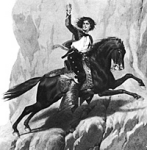 folk hero to fellow Spanish-speaking Californians, and his jail cell became a major tourist attraction that drew thousands of people. Vasquez was charming to all visitors; he even went so far as to pose for photos and sign autographs. His trial in January 1875 took four days, and the jury deliberated for only two hours before declaring him guilty of two counts of murder in the Tres Pinos rampage. He was sentenced to hang by presiding Judge David Belden, and as Vasquez awaited the day of his hanging, visitors to his jail cell continued to number in the thousands. At 1:35 p.m. on March 19, 1875, Tiburcio Vasquez was hanged by Santa Clara Sheriff Adams in San Jose and was buried in the old Santa Clara Mission Cemetery. Unlike Murieta, Vasquez never became a legendary figure and few today realize that he was once one of the most famous bandits in California.
In 1910, an enterprising man named Henry Krieg homesteaded the rocks. Recognizing the uniqueness of the area, Mr. Krieg built cabins on the property and then rented them to visitors. He also built a dam that supplied them water. During the Depression, visitors were charged 25 cents a carload to see the rocks. People have always been fascinated bythese rocks, and they have been used time and time again by the Hollywood studios as a backdrop for both movies and television. Prior to the advent of filmmaking, this area was simply known as “the Rocks”. The area became known as Vasquez Rocks probably after the filming of Zorro whose Hollywood character is modeled after the bandit Vasquez. Starting in the 1930s, Vasquez Rocks became a frequent backdrop on the silver screen, especially in Westerns. Stars such as Buck Jones, Tom Mix, John Wayne, Tom Keene, Fred Kohler and many others have been captured on celluloid among the rocks. In The Texas Ranger (1931), Jim Logan (Buck Jones) is an undercover ranger posing as a cowhand to help capture a gang turned outlaw. The gang is headed by Helen Clayton (Carmelita Geraghty) whose father was killed by Nevada (Harry Woods), a bad guy who has his men burning out the local ranchers. Vasquez Rocks are also easily identifiable in RKO's Son of the Border (1933) starring Tom Keene and in The Girl and the Gambler (1939) starring Leo Carrillo and Tim Holt. In the horror classic Werewolf of London (1935), Vasquez Rocks doubled as a mountaintop in Tibet where Dr. Wilfred Glendon (Henry Hull), who was on a botanical expedition, was attacked in the dark by a strange animal. Upon returning to London, he finds himself turning nightly into a werewolf and terrorizing the city, with his only hope for a cure being a rare Asian flower that is also being sought by Dr. Yogami (Warner Oland). Some of the B-Westerns of the 1940s to use Vasquez Rocks include Tex Ritter's Golden Trail (1940), Roy Rogers' Young Buffalo Bill (1940), Colorado (1940), Jesse James at Bay (1941) and Sunset on the Desert (1942), Don Barry's Arizona Terror (1942), Monte Hale's Along the Oregon Trail (1947), and Rex Allen's The Last Musketeer (1952). In Republic Pictures' Dakota (1945), Vasquez Rocks can be seen as John Wayne and Vera Ralston ride together in a stagecoach, and in Republic Pictures' The Last Musketeer (1952), Vasquez Rocks is not only visible throughout the movie, it also appears in the opening title scene. During the 1950s, several Technicolor productions utilized Vasquez Rocks including Sugarfoot (1951) starring Randolph Scott, Conquest of Cochise (1953) starring Robert Stack, Massacre Canyon (1954) starring Phil Carey, and Shotgun (1955) starring Sterling Hayden.
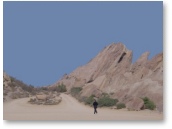 Its relative proximity to Los Angeles made Vasquez Rocks a favorite location site for the popular television Westerns of the ‘50s and ‘60s. The Lone Ranger, The Gene Autry Show, Cheyenne, Gunsmoke, Broken Arrow, Bonanza, Laramie, The Big Valley, Laredo, The Wild Wild West, The High Chaparral, and Hondo all used Vasquez Rocks in some of their episodes. Besides being a popular location for TV Westerns, Vasquez Rocks also doubled as Colonial India in the 1950s television series Tales of the 77th Bengal Lancers. This 26-episode series was produced by Screen Gems, a subsidiary of Columbia Pictures, and aired during the 1956-1957 television season. For the series, the studio erected a large fort on the level field between the major rock formation and the current Antelope Valley Freeway (Highway 14) at a cost of $117,843.17. After the series was cancelled, the fort apparently was left on site for several years until the Park Department finally torn it down for safety reasons.
Despite the waning popularity of Westerns in the late 1960s, Vasquez Rocks remained a popular location site for television productions with sci-fi themes. Star Trek, The Fugitive, The Six Million Dollar Man, The Bionic Woman, Battlestar Galactica, and Buck Rogers in the 25th Century are just a few of the TV programs that featured the rocks in their episodes. In Star Trek’s Episode 18, Arena (1/19/67), Vasquez Rocks was the uninhabited asteroid where Captain James T. Kirk (William Shatner) battled the lizard-like Gorn Commander (Bobby Clark). As expected, Kirk is the victor and boldly goes on to command the U.S.S. Enterprise for three more seasons. In Episode 27, The Alternative Factor (3/30/67), the Enterprise experienced a moment of 'nonexistence' while orbiting what was presumed to be a dead planet (Vasquez Rocks). A crew is sent down to explore the planet, and Captain Kirk finds a man called Lazarus who has incredible mood swings that make him sane and rational one minute and violently angry the next. This episode was actually filmed in sequence following Arena (Episode 18), but aired three months later.
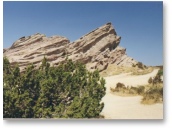 During the 1980s, the stars of such television programs as Hunter, Hell Town, and MacGyver were found chasing criminals over these rocks. Moviegoers of the 1980s would recognize Vasquez Rocks in the feature Short Circuit (1986) starring Steve Guttenberg, and in the 1990s Vasquez Rocks can be seen in Bette Midler's For the Boys (1991), John Goodman's The Flintstones (1994), Pauly Shore's In the Army Now (1994), Arnold Schwarzenegger's Jingle All the Way (1996), and Christian Slater's Very Bad Things (1998). More recent films of the big screen that have utilized Vasquez Rocks include Planet of the Apes (2001), Rat Race (2001), Jay and Silent Bob Strike Back (2001), and Bubble Boy (2001). In addition to movies and television shows, Vasquez Rocks has also appeared in many commercials including ones for Discover Card, 7-Up, Chrysler's Cruiser Car, and Taco Bell's “Run For the Border.”
Today, Vasquez Rocks Natural Area County Park is frequently visited not only by camerawork crews, but also by hikers, picnickers and sightseers. The Krieg family, who initially homesteaded these rocks, has since died and its members are buried here at the site.



